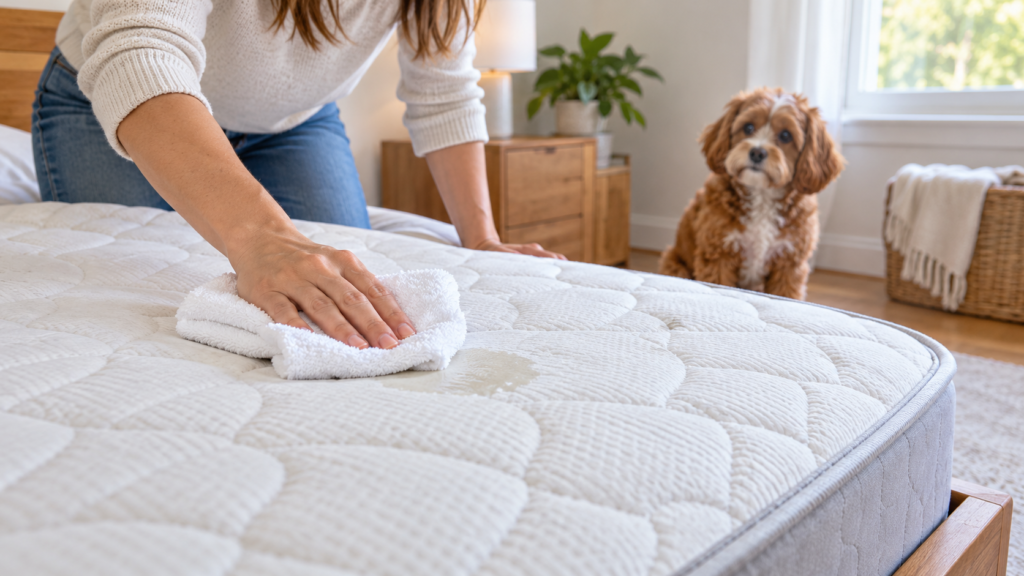
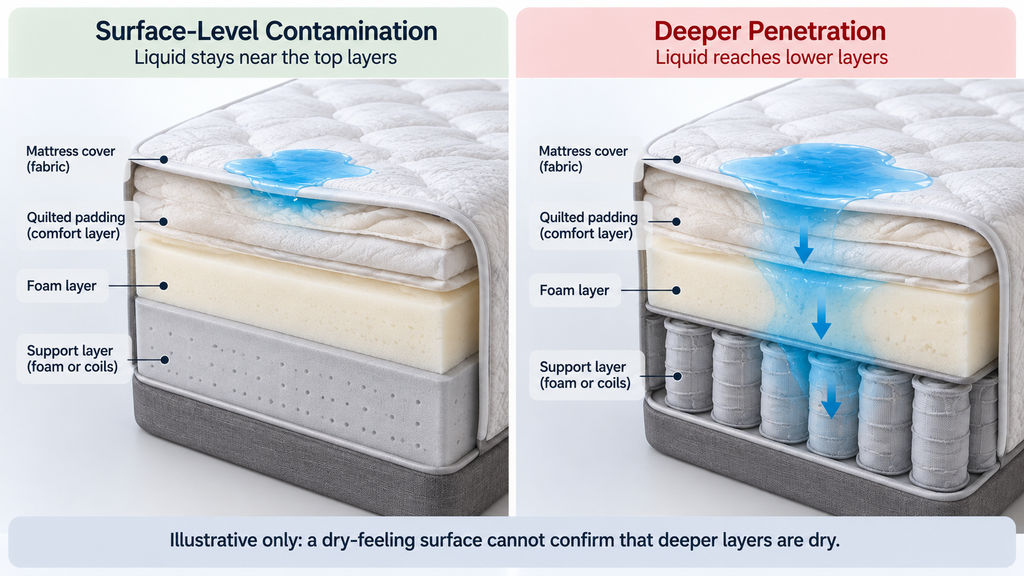
A dog urine accident on the bed is an urgent problem, but rushing in with buckets of soapy water or a steam cleaner can permanently ruin your bed. When cleaning dog urine from a mattress, the most important rule is never soak or saturate the mattress core. Unlike laundry or carpeting, mattresses contain thick layers of fabric, padding, and absorbent foam layers—sometimes surrounding innerspring coils—that can retain liquid deep inside. Trapped moisture creates a serious risk of internal mold growth, damages comfort layers, and can affect your warranty coverage.
To safely deal with dog urine, follow a quick three-step triage: strip all bedding immediately, check if your waterproof protector held, and blot fresh urine firmly with clean towels (press, never rub). If urine reached the mattress fabric, apply a minimal, low-moisture spot treatment approved by your mattress manufacturer and let the bed dry completely under cool airflow.
This guide covers care restrictions for memory foam, latex, hybrid, and smart beds, safe drying practices, and a decision framework for assessing whether cleaning or replacement may be appropriate.
Quick Summary: What to Do Right Now
- Act fast and blot: Strip the bed right away. Press dry paper towels or cotton cloths firmly into the wet spot to soak up as much liquid as possible. Do not rub or scrub.
- Check the protector: If you had a waterproof mattress protector, check that the mattress fabric beneath is dry and free from signs of leakage. If so, simply launder the protector and bedding according to their care labels.
- Low-moisture spot treatment only: Check your mattress care instructions first. If spot cleaning is permitted, use minimal moisture with a damp white cloth or an approved cleaner. If care instructions are unavailable, blot and dry first before applying liquids.
- Air-dry completely: Use cool airflow from a fan to dry the surface completely. Keep pets and children away from the treated area until it is fully dry and any cleaner residue has been removed according to the product label.
- Never soak or heat: Avoid steam cleaners, hot hair dryers, chlorine bleach, or pouring liquid cleaners onto the mattress.
Step 1: Initial Triage — Bedding, Protectors, and Immediate Blotting
Quick action can reduce the chance that urine sinks deep into the mattress core.
1. Strip and Wash the Bedding
Remove soiled sheets, pillowcases, and duvet covers immediately to prevent urine from soaking further downward. Launder bedding in your washing machine using standard detergent according to textile care labels.
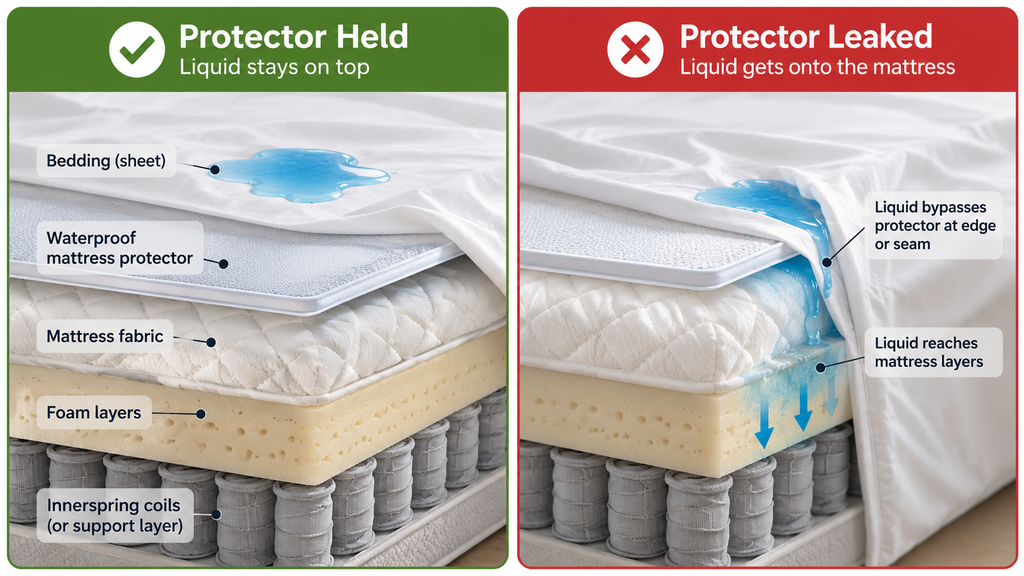
2. Check the Mattress Protector (The “Did It Hold?” Test)
Carefully remove the separate waterproof mattress protector or pad, if one was used, without transferring urine onto the mattress below. Do not unzip or remove the mattress’s built-in cover unless the care instructions for your exact model specifically allow it.
- If the protector held: Check that the mattress fabric beneath is dry and free from signs of contamination. If so, wash the protector on a gentle cycle with mild detergent according to its care label (air-dry or tumble-dry on low heat if permitted; avoid bleach or fabric softeners). No additional mattress spot cleaning is needed!
- If the protector leaked or was not used: Immediately proceed to blotting the wet spot on the mattress fabric.
3. Blot the Mattress Surface (Press, Do Not Rub)
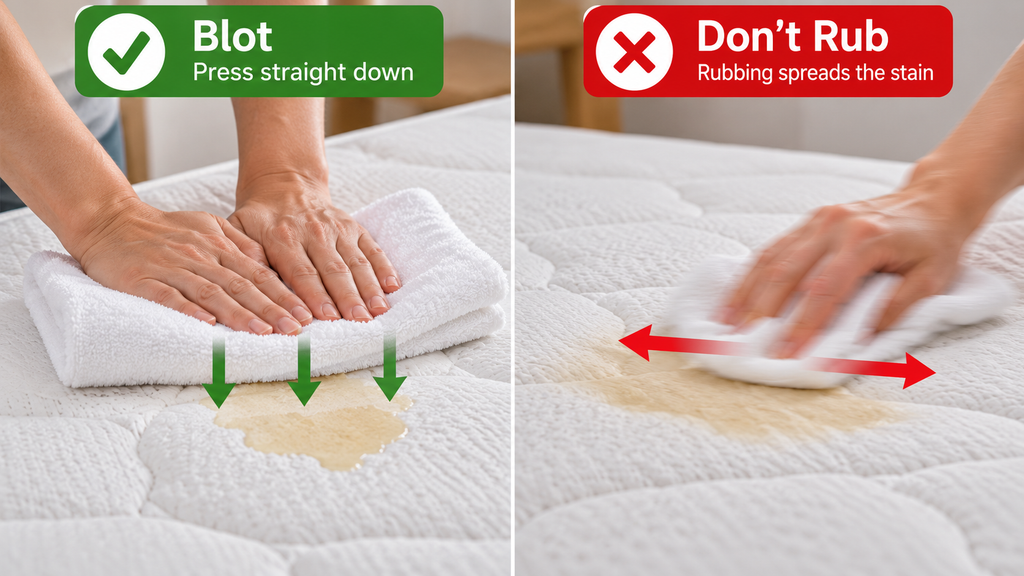
Place a thick layer of clean paper towels or white cotton rags directly over the fresh urine stain. Press down firmly with your hands for 30 to 60 seconds to draw liquid upward into the towels. Repeat with fresh towels until no more liquid transfers.
- Important: Do not rub or scrub fresh urine. Blot first to avoid spreading the wet spot or working liquid deeper into the mattress. A manufacturer’s later instruction to gently rub a surface mark is a separate, model-specific spot-cleaning step, not advice to scrub a fresh spill.
Step 2: Safe Spot Cleaning Methods for Surface Accidents
Before treating urine on mattress fabric, check the care instructions for your exact mattress model and built-in cover. Always use the smallest amount of liquid possible and follow both the cleaner’s label and your mattress maker’s guidelines. If you cannot identify the mattress model or its care instructions, blot and dry the area first with a clean towel and avoid experimenting with liquid cleaners until compatibility is confirmed. Keep pets and children away from the treated area until it is fully dry and any cleaner residue has been removed according to the product label.
Method A: Low-Moisture Spot Cleaning (When Care Guide Permits)
First check the instructions for your exact mattress model and cover. Some brands allow a white cloth barely dampened with cool water and a drop of mild detergent (such as Casper’s mattress cleaning guide); others specify water only (such as Sleep Number’s official care guide), and select covers can be unzipped and cleaned separately (such as specific Tempur-Pedic washable covers).
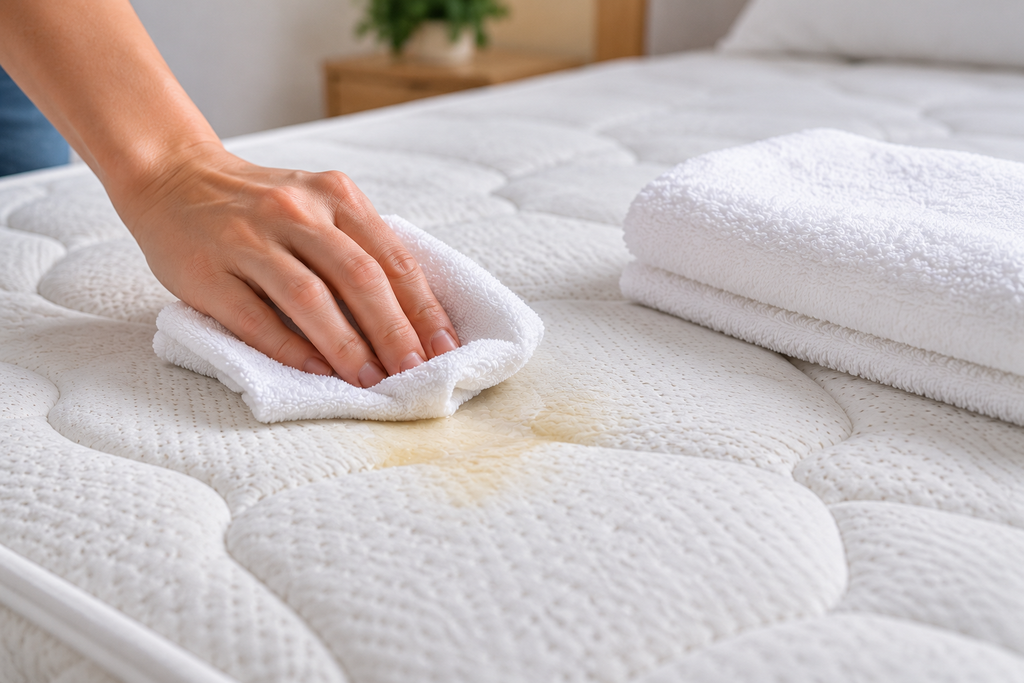
If damp spot cleaning is permitted, lightly dab the affected fabric with a clean white cloth, using only the amount and type of liquid allowed. Gently blot away excess moisture with a dry towel and let the area air-dry under cool airflow. Do not use soapy water on a mattress whose care instructions specify water only.
Method B: Pet Enzyme Cleaner (Only Where Compatible)
A pet-urine cleaner may help treat organic residues that the product can reach, but mattress care rules vary. Check both the cleaner label and the care instructions for your specific mattress and cover. For example, Purple’s mattress care guide permits a mild enzymatic spot treatment used sparingly, whereas other manufacturers caution against heavy chemical sprays.
Use a compatible product only in the amount and manner allowed by both guidelines. Follow the product label for application instructions. If the required application would soak the mattress or conflict with manufacturer guidance, do not use it on that mattress. Blot excess moisture thoroughly and let the area dry. A surface treatment cannot be assumed to remove urine absorbed deep into the core. If you need help choosing an appropriate cleaner, review our Enzyme Cleaner Selection Guide.
Method C: Dried Urine Stains
Once urine has dried, there is no fresh liquid left to blot from the surface. Consult your mattress model’s cleaning instructions before treating the remaining mark. Where permitted, use the low-moisture spot-cleaning method above or a compatible enzyme cleaner as directed. Avoid adding extra liquid or scrubbing aggressively. A persistent visible stain does not, by itself, establish deep contamination; conversely, removing surface discoloration does not prove that internal layers are clean.
Step 3: Material & Brand Care Restrictions
Different mattress materials tolerate moisture and cleaning agents differently. Always review your mattress maker’s official care instructions before spot-cleaning.
Memory Foam & Polyurethane Foam
- Key Restrictions: Never saturate foam mattress layers. Memory foam acts like a dense sponge, absorbing water rapidly and holding it deep inside.
- Prohibited Methods: Never use steam cleaners on memory foam; intense heat and moisture degrade foam cell structure and invite internal mold. Avoid chlorine bleach, harsh solvents, or ammonia-based cleaners.
- Brand Guidance: Tempur-Pedic spill guidelines explicitly require keeping the TEMPUR core completely dry. Casper’s mattress care advice warns against oversaturating foam, as trapped moisture degrades the support core.
Natural & Organic Latex
- Key Restrictions: Natural latex is durable but sensitive to harsh chemicals, solvents, bleach, and direct high heat.
- Brand Guidance: According to Avocado Green Mattress care instructions, water itself is not harmful to organic latex rubber, but soaking an assembled mattress traps moisture inside the internal layers. Avoid steam cleaners, harsh solvents, bleach, and direct high heat.
Hybrid & Innerspring Mattresses
- Key Restrictions: Hybrids combine pocketed coils with upper foam or comfort layers. Liquid applied to the surface can run down between coils or soak internal foam encasements.
- Brand Guidance: Purple’s mattress-care guidance advises avoiding steam cleaning on Purple mattresses, including the GelFlex Grid construction discussed in its cleaning guide.
Air Beds & Smart Beds (e.g., Sleep Number)
- Key Restrictions: Smart beds contain internal air bladders, foam pads, and electronic components.
- Brand Guidance: The linked Sleep Number care guide says not to remove, machine-wash, or dry-clean the mattress cover. After blotting fresh liquid, it describes using a white cloth lightly dampened with water to gently rub a surface stain and then air-dry fully. This limited spot-cleaning instruction is not permission to scrub fresh urine or soak the bed. Confirm the instructions for your exact model before proceeding. Do not vacuum directly on the mattress surface or spray air fresheners onto the ticking.
Quick Comparison: Mattress Materials & Care Rules
| Mattress Material | Primary Damage Risk | Conservative Cleaning Approach | Model & Brand Cautions |
|---|---|---|---|
| Memory Foam | Water retention, internal mold, cell degradation | Firm blotting; use only manufacturer-approved spot treatment; cool fan drying | Never saturate TEMPUR or memory foam; keep core dry (Tempur-Pedic) |
| Natural Latex | Trapped core moisture, rubber breakdown | Barely damp cloth with approved cleaning solution; firm blotting; fan drying | Avoid steam cleaners, solvents, bleach, or direct high heat (Avocado) |
| Hybrid & Grid | Liquid pooling in coils or foam encasements | Low-moisture spot cleaning; immediate blotting; thorough air drying | Avoid steam cleaners on GelFlex Grid or foam layers (Purple) |
| Air / Smart Beds | Cover shrinkage, bladder liquid entry, sensor damage | White cloth lightly dampened with water only; gentle dabbing; fan dry | Do not remove or wash outer cover; water only (Sleep Number) |
| Waterproof Protector | Membrane cracking, loss of waterproofing | Gentle machine wash (cool/warm water); air dry or low tumble dry | Follow care label; avoid chlorine bleach, fabric softeners, or high heat |
Step 4: Safe Drying Practices & Trapped Moisture Hazards
Controlling moisture during drying is just as important as the initial blotting. Absorbent internal foam holds water tenaciously and dries slowly.
How to Dry Your Mattress Safely
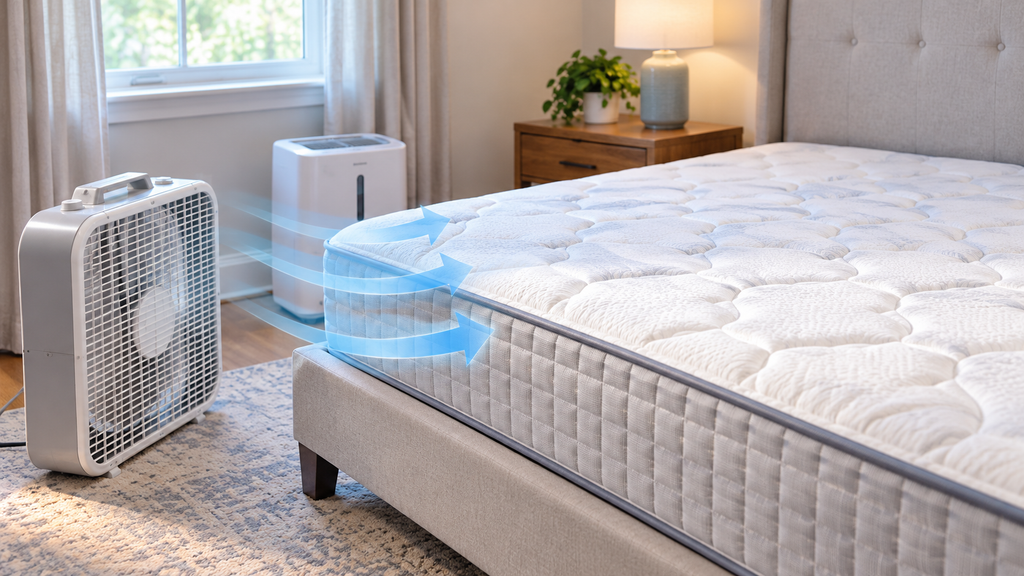
- Box Fans & Cross-Ventilation: Set up one or two box fans so cool air blows directly across the treated mattress surface.
- Dehumidifiers & Air Conditioning: Open windows when outdoor air will help lower indoor humidity; otherwise keep the room closed while using a dehumidifier or air conditioner to draw moisture out of the air.
- Uncovered Air Drying: Keep the mattress uncovered and exposed to airflow until it is completely dry.
Dangerous Drying Mistakes to Avoid
- No Direct High Heat: Never apply hot hair dryers, space heaters, or radiators directly to memory foam, latex, or waterproof backings. High heat warps foam structures and damages waterproof membranes.
- No Unprotected Direct Sunlight: While fresh air is helpful, direct, prolonged UV sunlight can dry out natural latex rubber and discolor synthetic fabrics.
Understanding Trapped Moisture & Mold Risks
A returning odor can indicate that urine residue remains in the mattress cover or deeper layers. Check that bedding and the protector are clean, and assess whether a deeper spill is likely. Odor alone does not show exactly where the residue is trapped.
Additionally, trapped moisture inside dense foam creates ideal conditions for mold. The U.S. Environmental Protection Agency (EPA) mold guidelines note that porous, absorbent materials (like internal mattress foam) that remain damp or develop internal mold can be difficult or impossible to clean completely and may need to be replaced.
Step 5: Clean or Replace? Deciding When a Mattress Is Saved
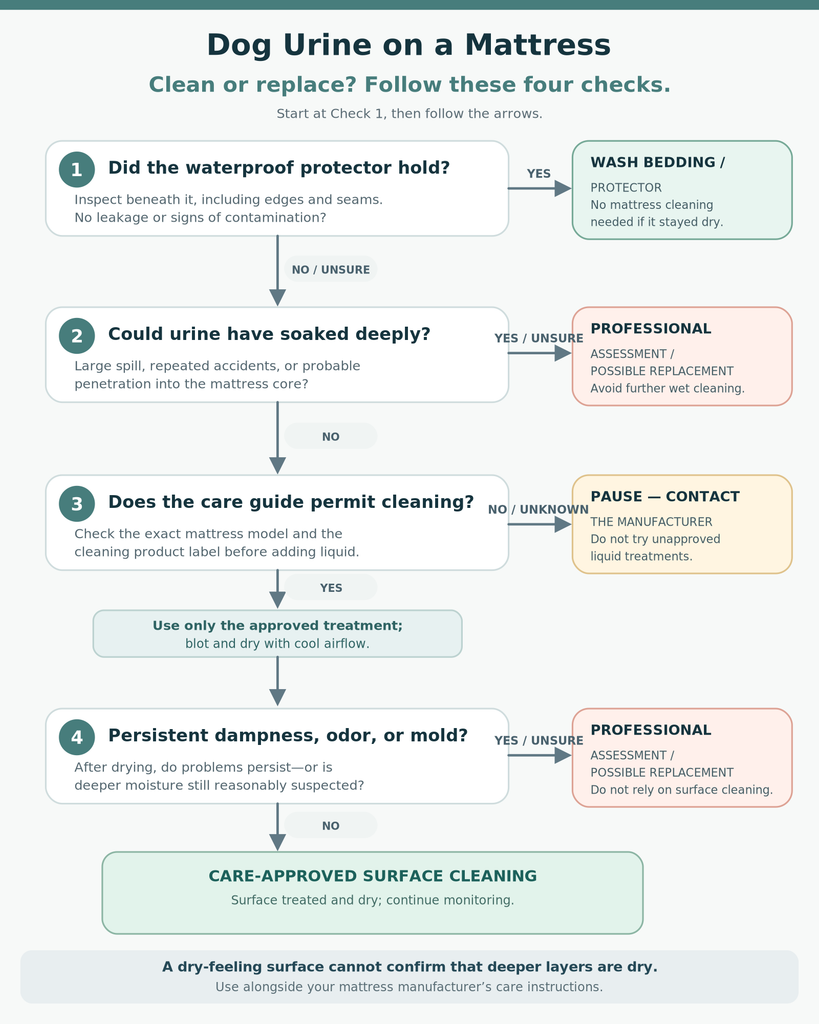
Not every mattress can—or should—be saved after a dog urine accident. Use this four-step decision framework to evaluate your situation:
- Protector Status: Did an intact waterproof protector contain the accident without leaking into the mattress cover? (If the mattress beneath is dry and free of odor, no further cleaning is needed.)
- Penetration Depth: Was the urine localized on the outer fabric, or did a large volume soak deep into the internal foam core?
- Care Label & Warranty Compliance: Were manufacturer care instructions followed, avoiding prohibited saturation or steam cleaning that could affect warranty coverage?
- Drying & Odor Outcome: Did the surface dry completely without persistent dampness, recurring strong odors, or signs of mold?
If you suspect deep-core saturation or mold, do not rely on further surface cleaning. You may ask the manufacturer or a qualified mattress-restoration professional whether assessment or remediation is feasible, but replacement may be the safer option where contamination or moisture cannot be adequately removed and verified.
Step 6: Prevention & Pet Health Considerations
How to Protect Your Mattress from Future Accidents
An intact, correctly fitted waterproof mattress protector can help stop urine from reaching the mattress core when properly maintained. Protectors with a waterproof membrane, such as TPU, can help prevent urine from reaching the mattress when the protector is intact and properly fitted. Check beneath the protector after an accident, especially near its edges and seams. Keep a spare protector in your linen closet so your mattress is never left unprotected on laundry day!
When to Check in with Your Veterinarian
If your dog is house-trained and suddenly begins urinating on the bed, do not assume it is purely a behavioral issue. As noted in ASPCA pet care guidance on medical causes of house soiling, medical problems should always be ruled out first when unexpected urination occurs, such as urinary tract infections, bladder stones, kidney disease, or incontinence.
Arrange a veterinary assessment for new or recurring house-soiling. Seek urgent veterinary care for painful urination or blood in the urine; if your dog repeatedly tries to urinate but produces little or no urine, seek emergency veterinary care (such as for a potential urinary blockage).
Frequently Asked Questions (FAQs)
My mattress cover has a zipper. Can I unzip and machine-wash it?
Only if your exact model’s instructions explicitly permit it. A zipper alone does not mean a cover is removable or machine-washable. While select models (such as specific Tempur-Pedic washable covers) allow machine washing on a gentle cycle, other models require the built-in cover to stay in place and be spot-cleaned only. Do not transfer one brand’s general cleaning advice to every model. Removing an unapproved cover can damage internal fire-barrier socks, cause severe shrinkage, or affect warranty eligibility. Check both the sewn-in care tag and the manufacturer’s exact-model instructions before unzipping; if they are unclear, leave the built-in cover in place and ask the manufacturer.
Why does the urine smell return when the bedroom gets warm or humid?
If urine odor returns after cleaning, urine residue may remain in the bedding, protector, mattress cover, or deeper layers. Check the removable items first and consider whether urine may have penetrated the mattress. Odor alone cannot establish how deep the contamination is.
Can I sleep on the mattress tonight?
Only after the affected area has dried adequately and there is no reason to suspect moisture remains inside. For a small, surface-level accident, keep the bed uncovered and use a fan until the treated area is fully dry. A cover that feels dry does not confirm that deeper layers are dry after a major spill. If you suspect deep saturation, notice persistent dampness or recurring strong odor, or see possible mold, avoid using the affected mattress until the problem has been assessed; replacement may be necessary.
Why should I avoid ammonia or chlorine bleach?
Avoid ammonia-based and chlorine-bleach cleaners unless the mattress manufacturer specifically permits a product. Harsh or incompatible chemicals can damage mattress fabrics and foam, and strong fumes can be irritating. Do not mix chlorine bleach with ammonia or acidic cleaners. For ordinary urine stains, follow the care guide’s approved spot-cleaning method instead.
Related Guides & Sources
Related Pet-Ready Home Guides
- Learn how to choose an appropriate enzymatic formula in our Enzyme Cleaner Selection Guide.
- Dealing with pet accidents on rugs? Read our Guide to Getting Dog Urine Out of Carpet.
- Freshen your home environment with our guide on How to Get Rid of Dog Smell in Your House.
Primary Sources & References
- Sleep Number Support: Cleaning Your Mattress & Care Instructions
- Tempur-Pedic Product Care: How Do I Clean a Spill on My Mattress? & Can I Clean the Cover of My Mattress?
- Casper Sleep Inc.: How to Clean a Mattress in 5 Steps
- Purple Mattress Care: How To Clean Urine From a Mattress: 7 Steps + Stain Removal
- Avocado Green Mattress Help Center: How to Clean Your Natural Mattress Without Harsh Chemicals
- U.S. Environmental Protection Agency (EPA): Basic Mold Cleanup Steps & Porous Materials
- ASPCA Dog Care: Separation Anxiety — “Medical Problems to Rule Out First”
- VCA Canada Animal Hospitals: Bladder Stones & Urinary Obstructions in Dogs